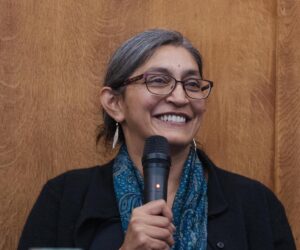
 Gurminder K Bhambra is Professor of Historical Sociology and Associate Dean for Research and Innovation in the Faculty of Social Sciences at the University of Sussex. She is a Fellow of the British Academy (FBA), of the Academy of Social Sciences (FAcSS), and the Royal Historical Society (FRHistS). She recently completed a Leverhulme Trust Major Research Fellowship project (2022-24) on ‘Varieties of Colonialism’. She has been President of the British Sociological Association and a Trustee of the Sociological Review Foundation.
Previously, she was Professor of Sociology at the University of Warwick and also Guest Professor of Sociology and History at the Centre for Concurrences in Colonial and Postcolonial Studies, Linnaeus University, Sweden (2016-18). In March 2017, she was Visiting Professor at EHESS, Paris; for the academic year 2014-15, she was Visiting Fellow in the Department of Sociology, Princeton University and Visitor at the Institute for Advanced Study, Princeton. She has also held Visiting Positions at the Department of Sociology, University of Brasilia, Brazil and at REMESO, Linköping University, Sweden.
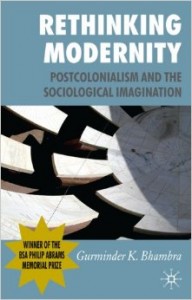 Her first monograph, Rethinking Modernity: Postcolonialism and the Sociological Imagination (Palgrave, 2007), won the 2008 Philip Abrams Memorial Prize for best first book in sociology. It addressed how, within sociological understandings of modernity, the experiences and claims of non-European ‘others’ have been rendered invisible to the standard narratives and analytical frameworks of sociology. In challenging the dominant, Eurocentred accounts of the emergence and development of modernity, she has put forward an argument for the recognition of ‘connected histories’ in the reconstruction of historical sociology at a global level. The second edition was published in 2023 with a new Preface, ‘From Rethinking Modernity to Reparatory Sociology,’ available online. Her argument for a global historical sociology is set out more fully in her second book, Connected Sociologies (Bloomsbury, 2014), which is open access and free to read at this link.
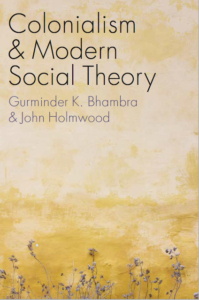 Her latest book, Colonialism and Modern Social Theory (Polity, 2021), is written with John Holmwood and makes an argument for rethinking the canon of social theory in the context of colonial histories. It focuses on five key sociological figures of the nineteenth and early twentieth century – Tocqueville, Marx, Weber, Durkheim, and Du Bois. The purpose is to expose the significance of colonialism and empire in the organisation of the thought of these writers and, thereby, in the legacies they bequeath to social theory. Addressing colonial histories is a necessary preliminary to the reconstruction of social theory.
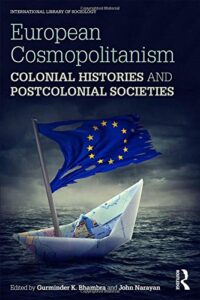 She has co-edited seven collections, Silencing Human Rights (with Robbie Shilliam, Palgrave, 2009); 1968 in Retrospect (with Ipek Demir, Palgrave, 2009); African Athena (with Daniel Orrells and Tessa Roynon, OUP, 2011); European Cosmopolitanism (with John Narayan, Routledge, 2017); Decolonising the University (with Dalia Gebrial and Kerem Nisancioglu, Pluto Press, 2018); Imperial Inequalities: The politics of economic governance across European empires (with Julia McClure, Manchester University Press, 2022); and the Sage Handbook of Global Sociology (with Lucy Mayblin, Kathryn Medien, and Mara Viveros-Vigoya, Sage 2024).
She has also organised special issues and sections of the following journals: Journal of the British Academy (Coming to Terms with Racial Capitalism; From the ‘Culture Wars’ to Reparative Histories); Current Sociology (Caste and its Implications for Sociologies of Inequality); Journal of Classical Sociology (review symposium on Colonialism and Modern Social Theory); Sociological Review (Roots, Routes, and Reconstruction: Travelling Ideas/ Theories); Sociology (Global Futures and Epistemologies of the South: New Challenges for Sociology) Current Sociology (on Theory for a Global Age: Coloniality, Power, and Critique, and on Knowledge Production in Global Context: Power and Coloniality); Journal of Historical Sociology (on Contesting Imperial Epistemologies, and on Translation and the Challenge of Interdisciplinarity); Interventions: International Journal of Postcolonial Studies (on Edward W. Said).
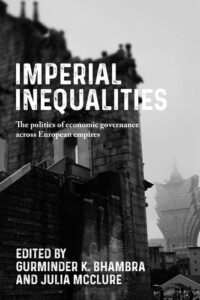 Her research interests are primarily in the area of global historical sociology and the political economy of colonialism. She has also been interested in the intersection of the social sciences with work in postcolonial and decolonial studies. Her current projects are on epistemological justice and reparations, varieties of empires, and the significance of colonialism to country houses.
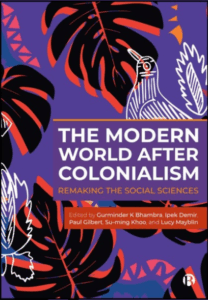 She is Series Editor of the Theory for a Global Age series, set up by Bloomsbury Academic and now published by Manchester University Press and, in 2015, she set up the Global Social Theory website to support students and academics interested in social theory in global perspective. She is also co-editor of the online magazine, Discover Society. In 2020, she set up the Connected Sociologies Curriculum Project (CSCP) which makes resources available to students and teachers for rethinking sociology. In 2026, Bristol University Press published a textbook of key lectures and resources from CSCP, as The Modern World after Colonialism: Remaking the Social Sciences. The book challenges long-standing assumptions within the social sciences and provides practical, classroom-ready resources. It enables teachers and students to approach familiar topics from new angles, opening space for more rigorous and inclusive debates.